Drive through the neighborhoods around downtown Cookeville and you are looking at houses that were framed up long before anyone thought about resale value. They were built to be lived in. That is exactly what makes them worth renovating, and it is also why the first week of work on one of them can be a surprise.
Josie Davis, who runs H&H Construction with her husband Alec, was asked on Unscripted Home Improvement what she actually likes about renovation work rather than new builds. Her answer is the reason we keep taking on older houses, and her follow-up is the reason we talk to homeowners about contingency before anybody swings a hammer.
There Is A Lot Of Beauty In The Bones
Josie’s case for renovation starts with the fact that you are not beginning from nothing:
“I think renovations are really special because you’re taking something that’s already there and already has flavor. It already has its own embodiment and you are tweaking it, aesthetically smoothing it out, maybe changing some of the rhythms there in the space, but you’re ultimately still keeping the foundation and the bones the same.”
That is a different job than building new. A house from the 1940s has proportions, millwork and framing that nobody specs anymore. You can take something worn and, in her words, “bring it up to speed with a new rhythm or a new flavor or a new perspective.” She likes seeing “history woven with new age and new influence.”
Then she said the part that gave this post its title.
Both halves of that sentence are true at the same time, and a homeowner needs to hear both before signing anything. The beauty is real. So is the other thing.
And Also A Lot Of Termites And Mold
Older houses in the Upper Cumberland have spent decades in a humid climate. Crawlspaces breathe moist air all summer. Gutters get clogged and quietly dump water against a foundation for years. Bathrooms that were retiled in the 1980s over the original substrate have been wicking moisture into a subfloor the whole time. None of that shows up in a walkthrough.
Two things we want to be straight about, because homeowners ask and the honest answer matters more than the confident one.
- Termite treatment is its own licensed trade. Finding the damage is a carpentry problem. Treating an active colony is a pest control problem, and it belongs to a licensed pest operator. We are not going to tell you a house is clear of termites because the framing looked acceptable to us.
- Mold is a health question before it is a construction question. If we open a wall and find staining, the right next step is assessment by someone who does that work, not a guess from a contractor holding a pry bar. What we can do is stop covering it back up and get the right person in front of it.
Most of what we find is not a disaster. It is a rotted sill plate under a leaking window, a joist end that has gone soft where a porch tied in, old knob-and-tube that somebody abandoned in place. Repairable, all of it. But it is work that was not on the original scope, and that is a budget conversation.
How We Budget For The Unknown
Here is the uncomfortable truth about pricing an older-home renovation: no contractor can hand you a genuinely final number before the walls are open. Anyone who does is either padding the bid heavily or planning to come back to you later with a change order you did not expect.
What we can do is be explicit about which parts of the estimate are known and which parts are assumptions. Cabinets, finishes, fixtures and labor on defined scope are knowable. What is behind the plaster is not. So the conversation we would rather have on day one is: what happens to this project if we open the bathroom wall and find the subfloor is gone?
Questions worth asking any contractor you are interviewing for an older home, us included:
- Which line items on this bid are firm, and which are allowances that could move?
- If you find something structural after demo, do I get a written change order before you proceed, or after?
- What is the process for stopping work and repricing, and who decides?
- Have you worked on a house of this age in this county before, and can I call that homeowner?
Josie’s framing on additions applies just as well to renovations: your budget has to be able to meet what you are actually asking for, and so does your timeline. A project that is priced with no room in it does not become cheaper when a surprise shows up. It just becomes a harder conversation halfway through. We would rather set the expectation early. That is the same instinct behind what to expect when you renovate an older Cookeville home, which walks through the wider scope questions in more detail.
The Inspection That Happens After Demo
To be precise about the word: this is not a code inspection and it is not a licensed home inspection. It is the look you get at a house the moment the drywall comes off, and on an older home it is more informative than anything that happened before you bought the place.
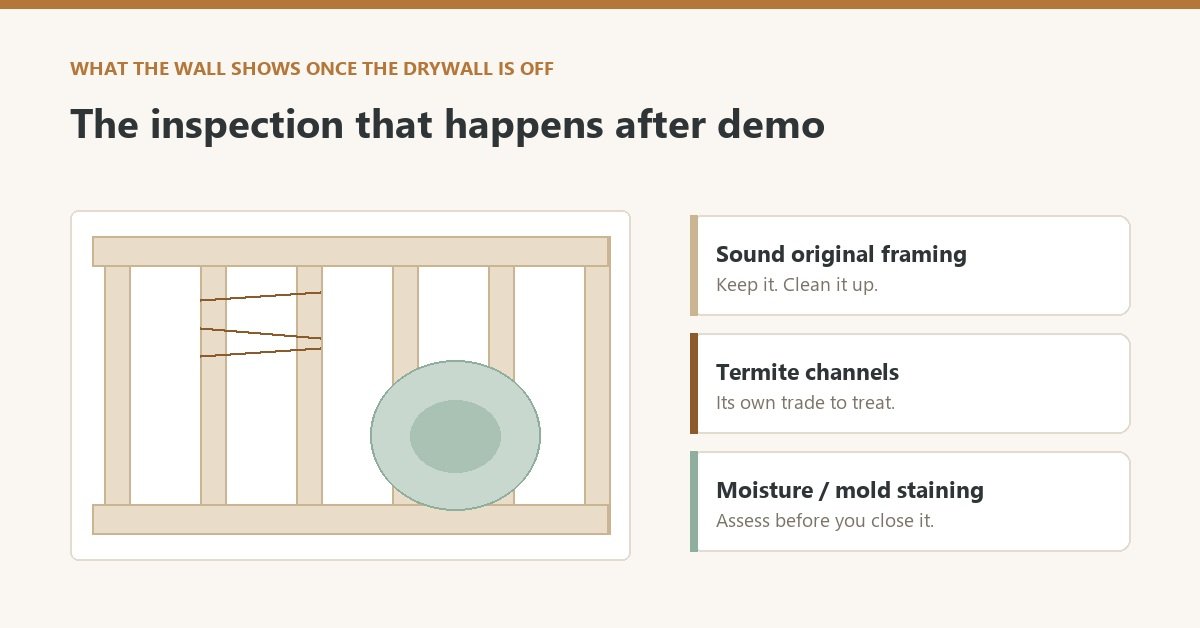
What we are reading in an open wall: whether the framing is true old-growth lumber that is still dead sound, where anything has been notched or cut for later plumbing runs, whether insulation is dry or has been holding water, whether previous work was permitted and done properly or improvised. A stain tells you there was water. Whether there is still water is the question that matters.
This is the point in a job where we want the homeowner physically in the house. Photos are fine, but standing in the room while somebody points at the joist is how you actually understand what you are being asked to spend money on. It is also where the relationship earns its keep, which is most of why we do this work the way we do.
When To Save The Original And When To Replace
Josie’s favorite results come from houses where almost everything gets upgraded but the character pieces stay. Floors get refinished rather than torn out while everything around them is brought current. She described customers keeping a fireplace even when it will never be lit again, because what they want is the brickwork and the mantel: “We clean it up, shine it up and polish it but we keep it with that character.”
A rough way to sort it. Save things whose value is that they cannot be bought new: original heart pine or oak flooring, solid interior doors and their hardware, plaster medallions and trim profiles, brick and stone, a mantel. Replace things whose only job is to work: wiring, supply and drain lines, insulation, single-pane sashes in a bedroom you actually sleep in, anything with active rot in it.
The gray zone is windows and siding, where the honest answer depends on condition and on how much the exterior character matters to you. That is a walkthrough conversation, not a blog conversation.
If you own one of these houses and you have been putting off a project because you are afraid of what is behind the walls: that fear is reasonable, and it is not a reason to leave a good house alone. It is a reason to open one wall early, with somebody standing there who will tell you the truth about what is in it. Have a look at the renovation work we take on, and come talk to us about your house.