At H&H Construction, we started the Unscripted Home Improvement Podcast because we believe the best home improvement advice comes from real conversations with the people doing the work — not polished marketing copy. This episode is a great example of that.
Jeremy Rivera sat down with Rick Heagarty, a Middle Tennessee entrepreneur who has spent 25 years building one of the region’s most complete home improvement portfolios. Rick talks openly about how he grew his companies, how he thinks about hiring and culture, and — most importantly for you as a homeowner — what you should look out for before signing any remodeling contract. Whether you’re thinking about a new exterior, a kitchen refresh, or finally tackling that overcrowded closet, this conversation will help you ask better questions and make a smarter hire.
Key Takeaways Before You Listen
- Pain points drive smart growth. Rick didn’t guess at new business categories — he asked customers what wasn’t working and added each new service only when the demand was clearly there. Listening to your market is a sustainable expansion strategy.
- Culture isn’t words on a wall. The real test is how people feel when they walk in. Trust, autonomy, and voice are the three markers Rick uses — and they apply equally whether you’re managing a team of five or fifty.
- The customer is not always right. Tolerating the wrong clients actively harms culture and output quality. A players can’t thrive when D-player behavior — from staff or from clients — is tolerated without consequence.
- The closet boom has a structural explanation. Municipal setback rules haven’t changed, so homes grow up, not out. The attic became the bonus room, and storage space disappeared. Custom closet and pantry systems are the direct response to a built-environment problem, not a trend.
- Vet your contractor before you sign anything. Check references, read reviews, look at past project photos, and insist on a line-item bid explanation. A contractor who won’t break out the numbers is a contractor who doesn’t want you to know what you’re paying for.
Meet Rick Heagarty
Jeremy Rivera: I’m Jeremy Rivera, Unscripted Home Improvement Podcast host. I’m here with Rick Heagarty, who has his thumbs in a number of different pies. Tell the audience a little bit about your expertise and why they should trust you as a home improvement expert.
Rick Heagarty: I’ve been in the home improvement business for 25 years — several different segments, from construction material supply all the way to actually doing the work in the home, not only for Mr. and Mrs. Jones, but also for businesses. We are business-to-business and also business-to-consumer. We know how to control the materials from manufacturer all the way to the final screw being put into a piece of hardware on a cabinet remodel job.
Jeremy Rivera: Tell me a little bit about some of the companies you’ve built out in that constellation of yours.
Rick Heagarty: Several companies, actually. I own a civil engineering firm — full land planning, land development, land survey and construction staking. 615 Design Group. Building material supply, which is exterior wholesale. Mid 10 Home Improvement — a business-to-consumer home improvement company that does everything from a very easy kitchen remodel to a very detailed exterior remodel. And then Southern Closets, our custom closet company. We manufacture closets for any type of budget — garage systems, master closets, pantries, linen closets. We touch quite a few different categories inside the house.
Quotes Worth Saving
“Culture is how you feel when you walk in the building. Our people feel like it’s theirs — they’re happy, they feel trusted, and they feel like they have a voice.”
“That old Sam Walton line — that the customer is always right — couldn’t be more wrong. It really pigeonholes you and pushes you into a corner trying to fix something that’s unfixable.”
“It’s really easy to start a job. It’s very difficult to finish it within the expectations, the timeframe, and the budget that the customer wants it done in.”
How Listening to Customers Built Four Companies
Jeremy Rivera: What is it about entrepreneurship — is it just addiction?
Rick Heagarty: When I was getting my MBA, vertical integration really hit home with me. The first business I started was an exteriors company — I’d worked corporately for a large building material manufacturer. As we built out every year, we would ask our customers: “Talk to me about pain points.” Different builders would tell us what pain points they had inside their building envelope, and we’d add that category as we felt it was appropriate. How we got into the residential remodel side was fielding lots of phone calls from families who wanted to redo decks, exteriors, and kitchens. Because we were only handling general contractors at the time, we decided to get into the residential side to help that homeowner complete their project. We added that as a category a few years after we started. Our business has been around for 15 years.
Rick Heagarty: The entrepreneurship part — I don’t know if I’m a serial entrepreneur other than I just see opportunity. I think entrepreneurs see opportunity differently than most people do. I’ve been working about 30 years — 15 years as an entrepreneur and 15 years in corporate America. I liked them both. I really loved the corporate culture and thrived in it. But I got to a point where I felt like I could do more — create a company where I could control the outcome, work with my friends, hire people I’ve known my whole life. You can’t really choose that in corporate America. When things are up it’s almost easy, but when things are down, everybody’s looking at me for the answers.
Rick Heagarty: The economics in Nashville right now aren’t great — money’s expensive — so there are a lot of challenges inside the construction industry right now.
Jeremy Rivera: Another serial entrepreneur I interviewed, Chad Jenkins, said the root of the word entrepreneurship is actually about somebody who adds value to systems. That’s kind of what you did through that journey — people wanted to improve their home and you added value by being able to deliver on each additional thing. I came from a corporate background myself — seven years commuting on the 91 freeway in California, spending up to two hours per day just to commute to work and work within a cubicle. What’s your mission statement within each of your companies, and how do you create a culture that reflects non-corporate values?
What Company Culture Actually Means
Rick Heagarty: People ask me about culture all the time, and I’ve heard people try to define it — but I think it’s how you feel when you walk in the building. Even though we have several companies, we all occupy the same space. The collaboration is fantastic and the communication is great. Our people really feel like it’s theirs. The young man who runs our Mid 10 company would tell you it feels like his — he has the autonomy to make the decisions he wants to make, because we hire the right people to make those decisions.
Rick Heagarty: If you put all of our people in one room, you’d see something very similar: they’re happy, they feel trusted, and they feel like they have a voice. We’ve had people come and go who wanted to expand their careers beyond what we could offer — say, into structural engineering rather than just land planning — and we’re very encouraging of that. We have a very open, transparent atmosphere. People can say what’s on their mind without fear of being pushed into a corner.
Rick Heagarty: From a mission standpoint, we just do what’s right. We train our people to see problems before the customers do — and fix them before the punch list is even created.
Why A Players Can’t Tolerate D Players — and Why the Customer Isn’t Always Right
Jeremy Rivera: There’s an aspect of marketing that’s almost performative — you have to tell people what you are, but if the backend culture is genuinely that way, it makes it much easier. In a smaller company, that mindset of ‘find the problem early and fix it’ makes your marketing message more authentic. How does that translate at your scale?
Rick Heagarty: Even though I’m in the construction segment, I’m really in the people development business. A players really cannot stand watching you tolerate D players. Certain customers fit us better than others. That old Sam Walton line — the customer is always right — couldn’t be more wrong. Accepting that pigeonholes you into trying to fix something that’s unfixable. Based on the culture of the business, we’ve done a really good job of identifying problems before they arise through training and leadership development.
Jeremy Rivera: That came up in a conversation about the happiest endings to campaigns I’ve worked on — when I fired the client because they wanted Black Hat tactics, the cheapest option at scale, short-term wins over long-term strategy. You’re not always the best solution for everybody every time. Trying to make yourself that makes you the wrong solution for more people.
Rick Heagarty: For sure.
Giving Back to the Community — Without a Marketing Agenda
Jeremy Rivera: I’m curious about your roots in Tennessee and how you’re connecting with the community. Even dispensaries like The Sanctuary are recognizing the benefit of connecting with a community — they recently did a “customer appreciation day”. From a marketing perspective, there’s always a great interchange of giving back to the community that can lead to positive outcomes. Have there been any initiatives — boards, Rotary, community cleanups?
Rick Heagarty: We’ve done a lot through the years. I personally sat on the board of trust for one of the local private schools for quite some time — a lot of outreach and community work. We’re always involved in different charities and giving back. We encourage all of our people to take time to give back, whatever the philanthropy is. We don’t do it from a marketing standpoint — we do it because it’s just right. If work comes out of it, great. But whether it’s getting involved in your local Rotary, the chamber of commerce, a golf outing that supports the Big Brothers Big Sisters — those kinds of things are really important, just to connect with people.
What’s Growing Fast Right Now: Exteriors, Kitchens, and the Closet Boom
Jeremy Rivera: What are some of the trends happening in home improvement that you’re really excited about? What positive developments are you seeing?
Rick Heagarty: There are really three things. People look at us in Nashville and the Middle Tennessee area as an exteriors company. Curb appeal is super important. We use a lot of James Hardie fiber cement — lots of different colors, exterior ornamentals, shutters, columns, corbels — things that really dress up the outside of the house. We have a great design team.
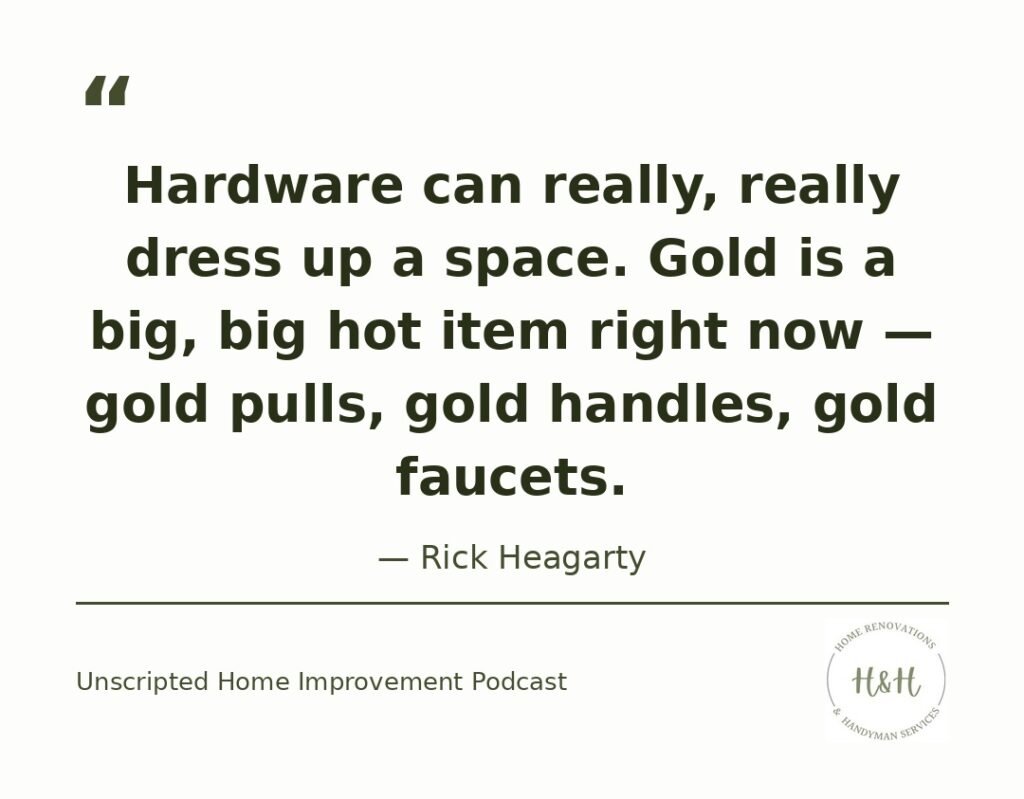
Rick Heagarty: From the inside standpoint, the kitchen category is where most people spend time in the house — everybody congregates in the kitchen. So exterior: when you pull up, the house looks nice. When you walk in, the kitchen matters. The types of countertops, cabinet colors, overlay styles, hardware — gold is a big hot item right now: gold pulls, gold handles, gold faucets.
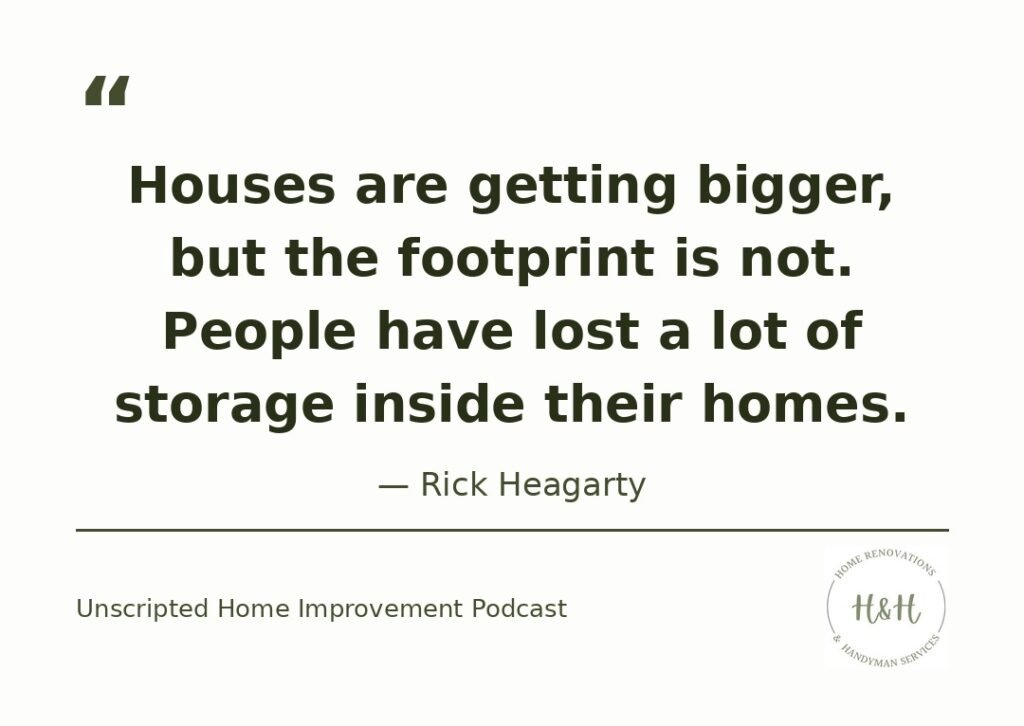
Rick Heagarty: The biggest thing we’ve seen though is closets. Houses are getting bigger, but the footprint of the house is not, because the setbacks inside the municipality stayed the same. The house isn’t growing on the property footprint — it’s growing inside. When I was a kid, the space over the garage was the attic. Today it’s called the bonus room. People have lost a lot of storage inside their homes. So organizing your closet, your linen closet, your pantry has created incredible spaces for us. Pulling down wire shelving and putting up a full custom closet system is probably the biggest growth we’ve seen in the last 12 months.
For more on what’s trending in Tennessee homes, see: Most Popular Interior Remodeling Trends for Tennessee Homes.
Serving Middle Tennessee — and Shipping Closets Nationwide
Jeremy Rivera: I do some consulting with a company that manufactures precast concrete firewalls, they started their concrete walls in florida… but they want to go national? Any advice?
What’s your viewpoint on delivering services locally versus supplying nationwide?
Rick Heagarty: For the closet piece, locally we cover the 10-county Middle Tennessee MSA area — from Columbia to Clarksville — and we service that area with full delivery on a daily basis. That’s a service area we can hit our on-time delivery commitments in. We’ve been able to extend closet systems nationwide for do-it-yourselfers — simpler systems with an instructional guide for self-installation. For more complex local installs, our team goes out and installs. We’re also shipping building materials all over the Southeast. CDL drivers are at a premium right now, so we’re very careful on jobs we take outside the closet business from a shipping standpoint.
What Every Homeowner Should Know Before Hiring a Contractor
Jeremy Rivera: I want to give you a chance to stand on a soapbox and tell the people what is going wrong in home improvement and how it needs to be turned around.
Rick Heagarty: Just about anyone can get into the construction business today. There are a lot of remodelers out there, and I don’t think people are doing a very good job of checking references and really diving into the experience that the remodeler has. Don’t get sucked into a cheap price. It’s really easy to start a job. It’s very difficult to finish it within the expectations, the timeframe, and the budget the customer wants. I’d encourage people to check references, read Google reviews, look at pictures of existing work, and call someone to ask: “Talk to me about how these people work.”
Rick Heagarty: You’re letting people into your home — it’s an intimate setting. When we redo a closet, we’re in the intimate part of people’s lives. You want to be able to trust them, know that they do good work and can finish. The expectation the homeowner has — you want that met.
Rick Heagarty: I encourage everyone to check, look, read, talk, and really dig into a bid. Some people get offended when you ask them to break out the numbers. We don’t. We want to tell them exactly what they’re getting for the money they’re spending.
Jeremy Rivera: I absolutely agree — that came up with Josie Davis of H&H, who reinforced that you’re essentially moving in with somebody for a full remodel. Trust and verify. Don’t go with the cheapest proposal — go with the one that will fit your needs long-term.
Rick Heagarty: And if it is the cheapest — great, you win. But first: get in, dig in, pull it apart. We have no problem sitting down with somebody and explaining why we feel we’re worth what we’re charging. We don’t win every job. When someone tells us no, that doesn’t mean no forever — it just means no right now. We’ve got a good system for getting back with people who tell us no.
Find Rick Heagarty and His Companies
- 615 Design Group — Civil engineering, land planning and development
- Land IQ — Land survey firm
- Mid 10 Home Improvement — Exterior and interior remodeling, Nashville’s only James Hardie Elite Alliance contractor
- Southern Closets — Custom closets, pantries, and garage storage systems in Nashville, with nationwide DIY shipping
Also see: The Benefits of Custom Garage Storage Systems · Ultimate Guide to Decluttering Before Your Custom Closet Install
About the Unscripted Home Improvement Podcast
The Unscripted Home Improvement Podcast is produced by H&H Construction in Cookeville, Tennessee. Host Jeremy Rivera interviews home improvement professionals across every trade to help homeowners across Middle Tennessee make smarter decisions before their next project.